Mount Fuji is more than Japan’s most famous view. It is a sacred place, a source of art and water, and a living landscape. This journey begins at its historic southern front.
The world knows Mount Fuji. Now meet its historic front.
Rotate the mountain through 360 degrees, change the season and light, and then return to the view that has welcomed pilgrims from the south for centuries.
The mountain does not offer one permanent postcard. Snow, cloud, cherry blossom, summer green and the changing angle of the sun redraw it throughout the year.
01 / 04Spring
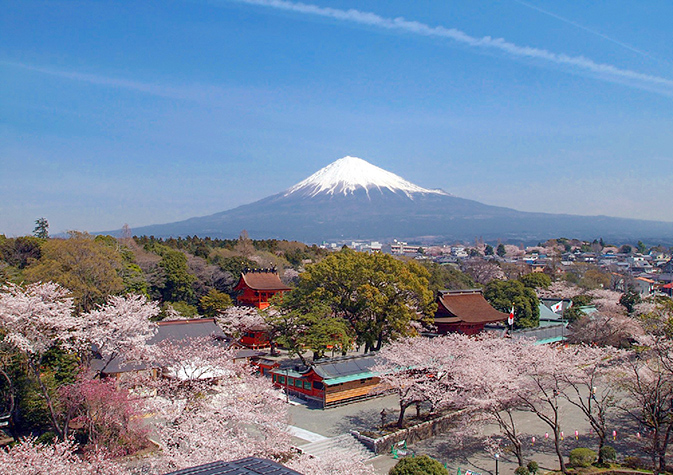
Cherry blossoms and the last snow share the frame.
Mount Fuji is not separate from the life below it. At the southern foot, belief, water, art and an ordinary city meet in one continuous landscape.
01
BELIEF · PILGRIMAGE · ART
A mountain worshipped, not only viewed.
In 2013, UNESCO inscribed Fujisan as a sacred place and source of artistic inspiration. The World Heritage property includes pilgrimage routes, shrines, lakes, waterfalls and viewpoints—evidence that the mountain’s meaning lives far beyond its summit.
Fujisan Hongu Sengen Taisha · Fujinomiya Tourism Association
02
SNOW · VOLCANIC ROCK · SPRINGS
The mountain returns as water.
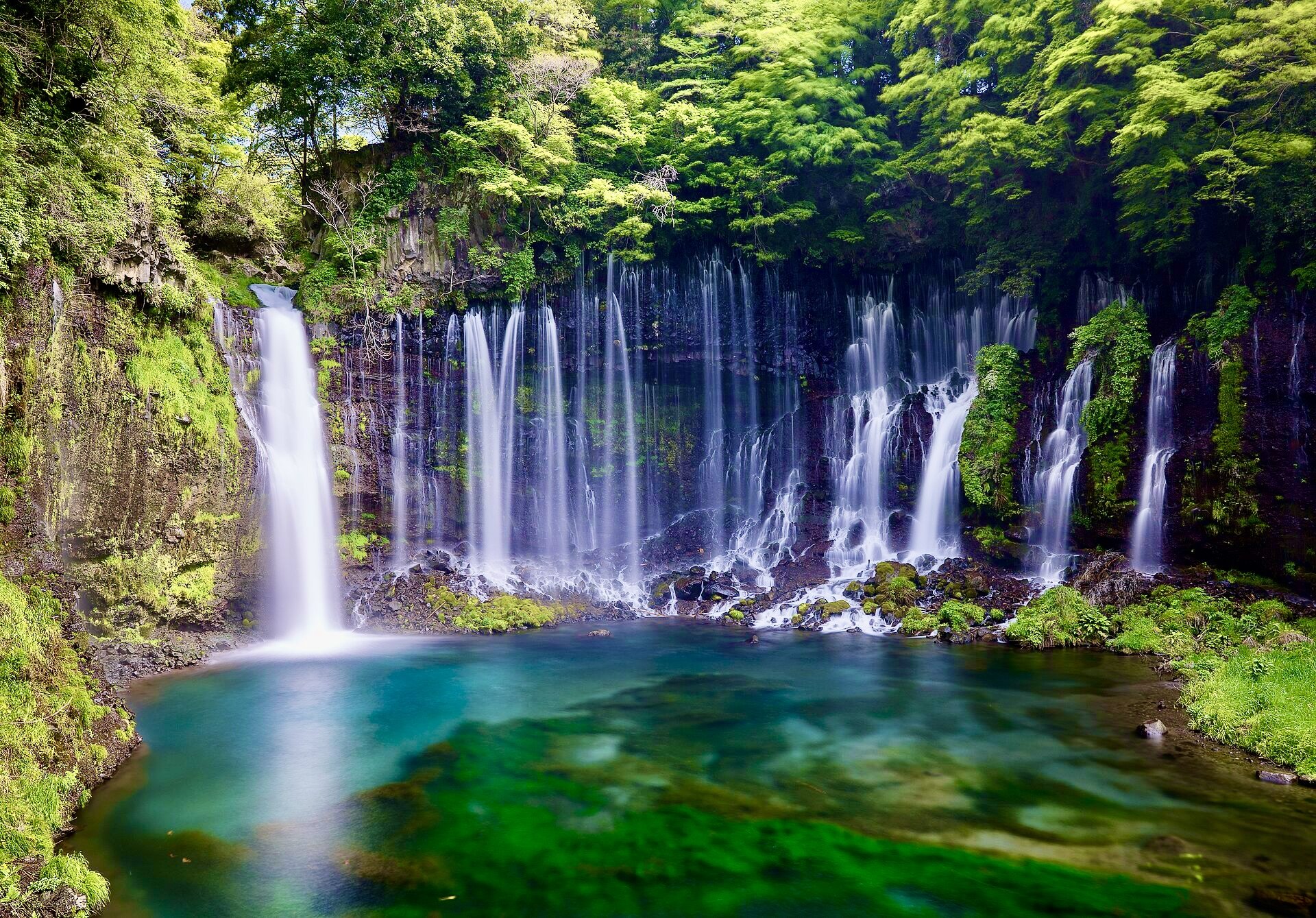
Rain and snow pass through layers of volcanic ground before reappearing as springs and waterfalls around the lower slopes. In Fujinomiya, the mountain is not only on the horizon—it runs through the landscape.
Shiraito Falls · photograph supplied to OMOTEGUCHI
03
DAWN · SEASON · VIEWPOINT
Light changes the destination.
At Lake Tanuki, the rising sun can meet the summit around late April and late August, creating Diamond Fuji. The exact day and view move with your position and the weather—a reminder that seeing Mount Fuji is an encounter, not a guarantee.
The world knows the silhouette. Few know where its story begins.
Fujinomiya sits on Mount Fuji’s south-western foot. Here the head shrine of Sengen worship, spring water, the city, and a climbing trail rising to 2,400 metres belong to the same journey. OMOTEGUCHI means “the front entrance.”
Use this as orientation, then confirm current transport, hours, weather and trail rules with the official sources linked below.
01
ARRIVE
Tokyo → Shin-Fuji
The Tokaido Shinkansen reaches Shin-Fuji Station. Continue towards Fujinomiya by the transport that fits your destination.
02
BEGIN
Shrine → water → landscape
Start around Fujisan Hongu Sengen Taisha and the World Heritage Centre, then follow the mountain’s water towards Shiraito Falls, Lake Tanuki and Asagiri.
03
ASCEND, IN SEASON
Fujinomiya Trail
Long before the modern fifth-station trailhead, this southern ascent was a pilgrimage. The historic Omiya–Murayama route began at Fujisan Hongu Sengen Taisha, passed Murayama, and continued towards the summit. Today’s climb has seasonal closures, entry procedures and changing safety conditions; always use the official climbing site before departure.
Fujinomiya brings together the mountain’s southern view, the head shrine of Sengen worship, spring-fed landscapes and the highest starting point among Mount Fuji’s four summer climbing routes. It lets a visitor understand the mountain as culture and place, not only as a photograph.
What were the Fuji-ko, and why is Mount Fuji sacred?
Fuji-ko were pilgrimage societies that spread from the 17th century and enabled more ordinary people to take part in Mount Fuji worship. They belonged to a longer history: ancient worship from the foot, medieval ascetic climbs, purification at springs and lakes, and journeys to the summit. On the southern side, Yamamiya preserves direct worship of the mountain, while the historic Omiya–Murayama route began at Fujisan Hongu Sengen Taisha and passed Murayama towards the summit.
Can Mount Fuji be climbed all year?
No. The official summit trails open only during a defined summer season and are closed outside it. Dates, fees and access rules can change; check the official climbing website immediately before planning or departure.
When is Mount Fuji easiest to see?
Visibility varies hour by hour. Cooler months often bring clearer air, and an early start can help, but cloud can hide the mountain in any season. Build a trip around the wider culture, water and landscape rather than one guaranteed view.
What can I experience on OMOTEGUCHI?
You can rotate a terrain-based Mount Fuji through 360 degrees, change the season and time of day, explore water and light, and build a personal trip list. It is an independent editorial experience, not a booking service or a mountaineering safety forecast.
THE FRONT IS NOT A DIRECTION. IT IS A WAY IN.
Mt. Fuji has a front. This is it.
Rotate the mountain. Follow the water. Find the light. Then make the journey your own.